Explain Different Types of Keys in Dbms With Examples
To define a field as primary key following conditions had to be met. For Example STUD_NO STUD_NO STUD_NAME etc.
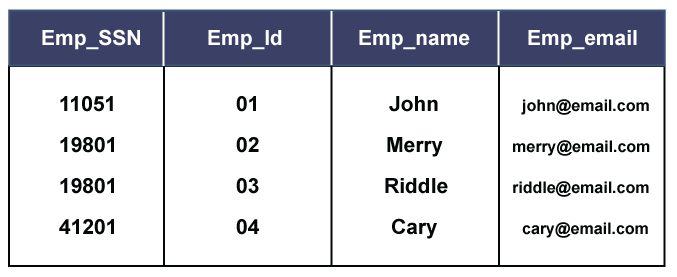
Alternate Key In Dbms Javatpoint
Moreover keys are necessary in recognizing any.
. A unique key in DBMS is a key that is able to identify all the records of a table uniquely. Primary key It is the first key used to identify one and only one instance of an entity uniquely. In the above-given example Student ID SRollNo SName Surname Email are superkeys.
A candidate key is a super key but vice. The primary key field. Candidate key A candidate key is an attribute or set of attributes.
No two rows can have the same primary key value. They are crucial for the arrangement of tables in the database. Every row must have a primary key value.
Keys in DBMS is a set of attributes that can identify each tuple uniquely of the given relation. Primary Key - student_id Foreign Key - course_id Alternate Key - first_name last_name Composite Key - first_name last_name You may also like - Database Interview. Types of Keys in DBMS 1.
These are used in identifying and establishing relationships between tables. DBMS vs RDBMS Types of Keys in DBMS. Keys are of seven broad types in DBMS.
For the above example. Adding zero or more attributes to the candidate key generates the super key. Key plays an important role in relational database.
A nullable primary key can contain blanks numbers or a combination of both. Nullable primary keys must not be null and cannot. There are broadly seven types of keys in DBMS.
Keys are an integral element of Relational database model. Different types of keys The different types of keys in the database management system DBMS are as follows Primary key Super key Candidate key Alternate key Artificial. Different Types of Keys in DBMS are- Super key Candidate key Primary key Alternate key.
It is used for identifying unique rows from table. But this primary key is large and complex so DBA decides to add row_id column. Primary Key The primary key refers to a column or.
The word unique defines a thing which is unique from other things. 7 Different Types of Database Keys Explained with Example Keys play a very important role in DBMS. Enrollment table from business point of view has student c1ass combination as primary key.
Different Types of Keys in DBMS- Super key Candidate key Primary key Alternate key Foreign key Partial key Composite key Unique key Surrogate key Secondary key. Candidate Key Primary Key Foreign Key Super Key Alternate Key Composite Key Unique Key 1. The set of properties like roll no name class age sex is a super key for the relation student.
Candidate keys in DBMS. Types of keys in DBMS. A nullable primary key uniquely identifies each row in a table.
A primary key PK is a column of a table or a set of columns that helps to recognisedidentify every. Keys in DBMS Types of keys. Unique Key in DBMS.
Of a student is unique in relation. It also establishes relationship among tables. A key that consists of more than one attribute to uniquely identify rows also known as records tuples in a table is called composite key.
2 Primary Key The primary key is a column or column group in a table that defines.
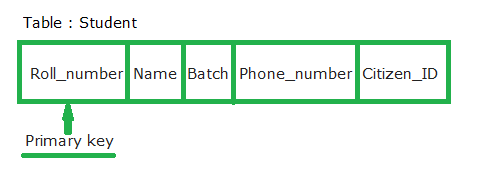
Difference Between Primary Key And Unique Key Geeksforgeeks
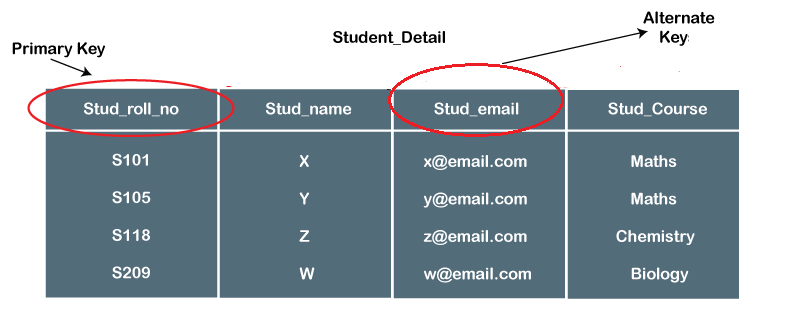
Alternate Key In Dbms Javatpoint
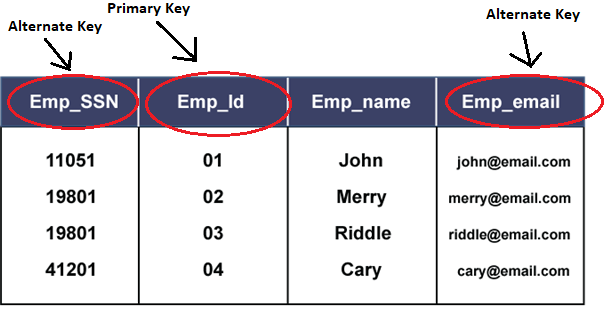
Alternate Key In Dbms Javatpoint
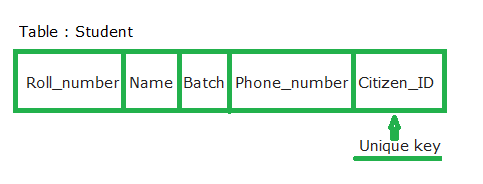
Difference Between Primary Key And Unique Key Geeksforgeeks
No comments for "Explain Different Types of Keys in Dbms With Examples"
Post a Comment